
Find Your Stage, Plan Your Treatment
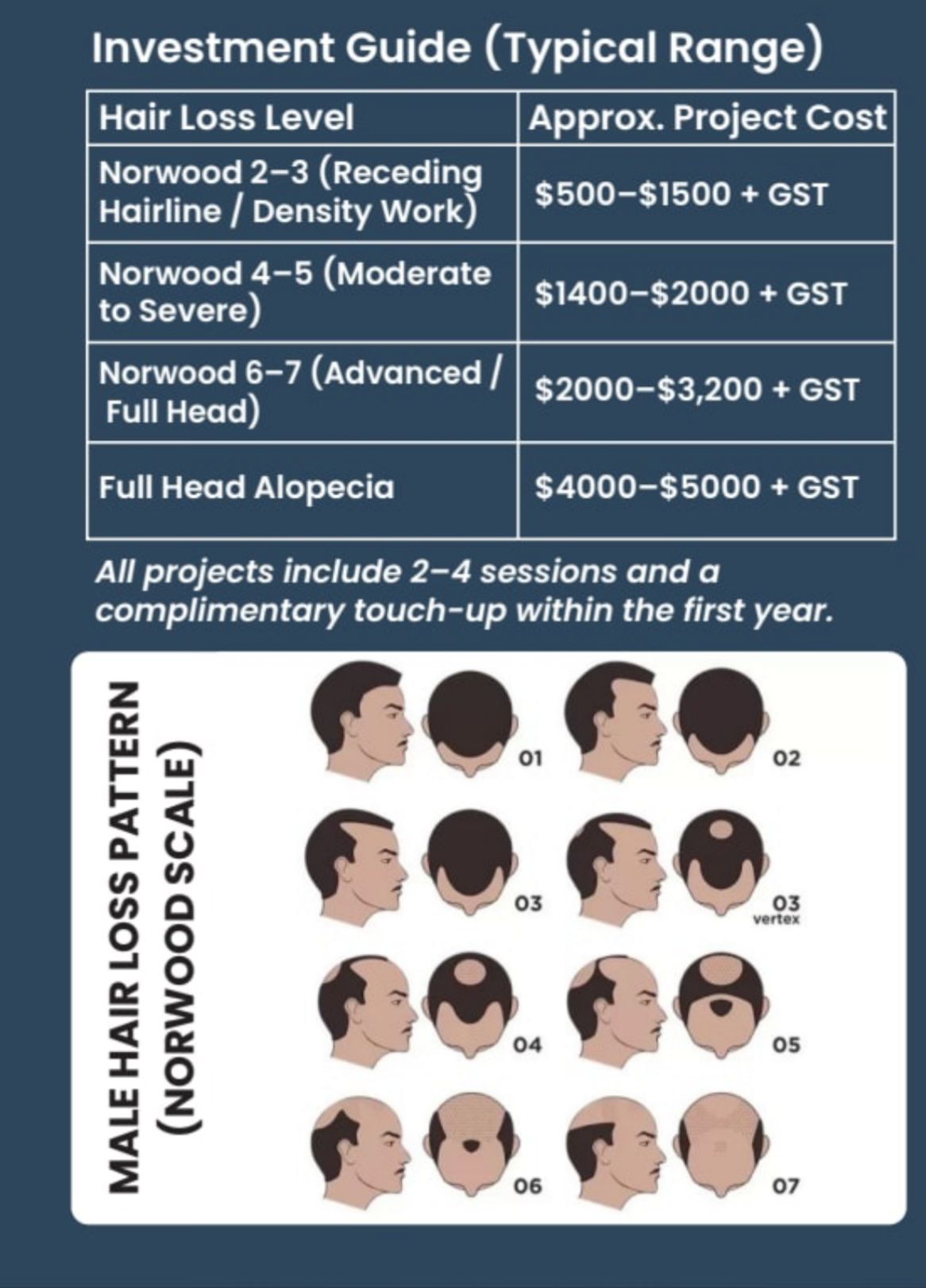
The Norwood Scale is a widely accepted system used to classify the stages of male hair loss, ranging from minimal thinning to advanced baldness.
Knowing your Norwood stage is valuable because it gives you a clear picture of your hair loss pattern, helping you make informed decisions about SMP treatment. It allows specialists to plan the right hairline, coverage, and density, while giving you realistic expectations and accurate treatment estimates.
Understanding your stage also helps track hair loss progression over time, ensuring any future treatments remain consistent and natural looking.
Norwood Stages
Stage 1 – Minimal or No Hair Loss
- Hairline intact; little recession.
- SMP Tip: Subtle density boost or hairline refinement for a youthful look.
Stage 2 – Mild Recession
- Slight temple recession.
- SMP Tip: Temple restoration and minor density work create a natural hairline.
Stage 3 – Noticeable Recession
- Deep M-shaped temples.
- SMP Tip: Hairline reconstruction with added density for fuller appearance.
Stage 3 Vertex – Crown Thinning
- Bald spot appears on crown.
- SMP Tip: Combine front and crown coverage for uniform, natural results.
Stage 4 – Moderate Balding
- Front recession and large crown bald spot.
- SMP Tip: Connect hairline and crown for balanced scalp coverage.
Stage 5 – Advanced Hair Loss
- Bald areas at front and crown almost join.
- SMP Tip: Larger coverage area; multiple sessions to ensure density and realism.
Stage 6 – Extensive Balding
- Front and crown fully connected; sides remain.
- SMP Tip: Full scalp coverage with careful blending for natural look.
Stage 7 – Severe Balding
- Only a thin horseshoe of hair remains around sides.
- SMP Tip: Focus on replicating density along sides and back to maintain natural scalp appearance.
Understanding your Norwood stage is the first step toward achieving the best results with Scalp Micropigmentation. By identifying your specific pattern of hair loss, you and your SMP specialist can create a treatment plan tailored to your needs—whether it’s subtle density enhancement or full scalp coverage.
Knowing your stage also helps set realistic expectations, track hair loss over time, and ensure consistent, natural looking results for any future sessions. .
